
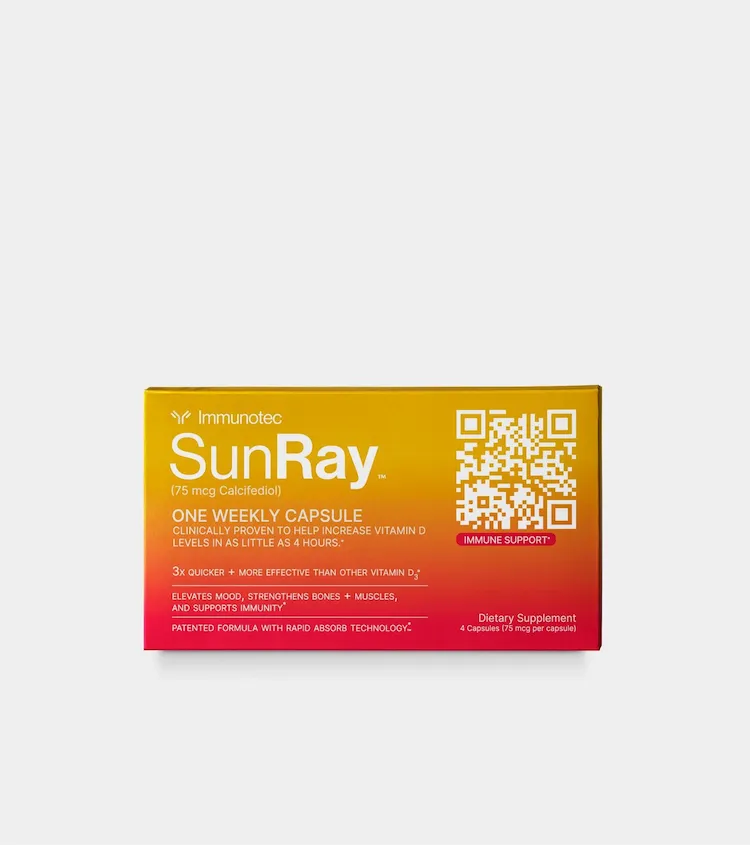
What to know about Sunray
Most people who take vitamin D take it daily and forget it roughly as often as they remember it. Sunray is built around a once-a-week dose instead, which is a great deal easier to keep up.
The reason it can work weekly is the form. It uses calcifediol, also called 25-hydroxyvitamin D, which is a step further along the conversion pathway than standard vitamin D3 and therefore usable by the body faster.
Vitamin D contributes to the normal function of the immune system, to the maintenance of normal bones and teeth, and to normal muscle function. It also supports the absorption of calcium, which is why the two are so often taken together.
Key Benefits
- Supports normal immune system function
- Contributes to the maintenance of normal bones and teeth
- Supports normal muscle function
- Calcifediol, a faster-acting form of vitamin D
- Once-weekly dosing rather than a daily tablet
Common questions about Sunray
What is calcifediol?
Calcifediol, also called 25-hydroxyvitamin D, is the form of vitamin D your liver makes from vitamin D3. Because that conversion step is already done, the body can use it faster. It is the form of vitamin D in Sunray.
Calcifediol or vitamin D3: what is the difference?
Vitamin D3 has to be converted by the liver before the body can use it. Calcifediol is the already-converted form, one step further along, so it raises vitamin D status more quickly than the same amount of D3.
Why is it taken weekly rather than daily?
Vitamin D is fat-soluble and stored by the body, so a weekly dose is workable, and it is far easier to remember than a daily tablet.
Should I take it with calcium?
They work well together, since vitamin D supports calcium absorption. Speak to a healthcare professional first if you take medication or have a medical condition.
Related products
Worth looking at alongside this one: Calcium-D From Milk, 90-Day Sunray Pack, Immunocal.